
Jun 26, 2025
Low-Hanging Fruit
Esters come to beer from hops, and also via certain biotransformations performed by yeast. Phenolics can come from multiple sources, too — primarily from malts, but also via yeast biotransformation. Consequently, yeast choice can substantially affect the flavor and aroma characteristics of a beer. In order to let fruit character shine more, with Belgian and Hefeweizen strains, brewers know they can turn up the ester production that yeast is responsible for with things like temperature control and pitch rate. Interestingly, however, when the spiced, clove-like character of phenolics and the fruity characteristics of esters are tasted together, we perceive esters less, even though ester content hasn’t changed.
Phenolics overshadow some ester perception to our senses. That means another way to increase ester perception would be for there to be fewer/less phenolics masking the esters present — effectively allowing them to step out from under the shadow. Using their knowledge of yeast (and brewing history) Omega Yeast’s research team set out to make this possible.
They were curious:
- What would the ester profile in a phenolic strain present like without the phenolics?
- Would the absence of phenolics produced by that strain increase the beer’s perceived fruitiness overall?
Let’s look into it!
Random Mutations Are What Made Non-Phenolic Strains
Most strains that are non-phenolic naturally acquired an inactive copy of the FDC1 gene from centuries-old mutations. Then, brewers, favoring POF- strains’ new, clean flavor profiles, perpetuated them during the advancement of pure culturing techniques in the late 1800s.
There are three naturally occurring POF- mutations known to exist in various brewing strains: one is called the fdc1-C460T substitution.
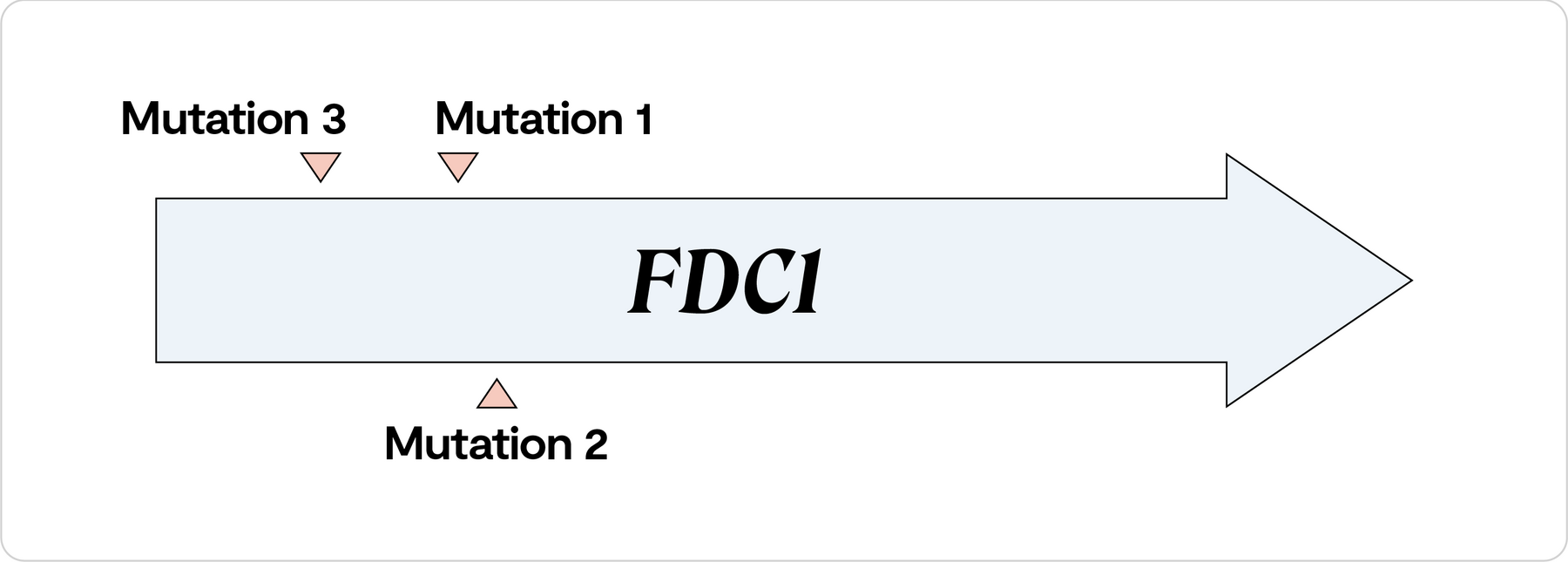
Mutation 1 is FDC1-C460T
It doesn’t matter whether a strain carries one or multiple of these mutations, any will disrupt the gene and cause yeast-contributed phenolics to be f…ph…inished.
- Mutations 1 and 2 are the most common across all brewing strains.
- Mutation 3 is unique to Tropical IPA, which tells researchers Tropical IPA likely evolved on a separate path (it also has the unusual trait of being diastatic).
Repurposing History
Inspired by the effect of the fdc1-C460T inactivation in POF- yeast (mutation 1) — the same inactivation of the FDC1 gene the brewing industry’s favorite workhorse strain West Coast Ale I has, for example — Omega Yeast’s R&D team selected phenolic strains whose perceived ester profile and brewing characteristics were already popular, so whose fruity profiles were likely to stand out even more without the phenolics, and introduced the gene inactivation using CRISPR-Cas9, a modern gene-editing process.
The FDC1 substitution could have been accomplished through something like hybridization, say, but with CRISPR-Cas9 it was possible to introduce just the one precise and targeted change, leaving the rest of the strain’s characteristicswhole and untouched.
Bears fruit
As expected, intentionally introducing the historical POF- mutation successfully disrupted the production of 4VG in these now-new strains.
The absence of phenolic character allowed both yeast esters and complementary hop fruitiness to come forward in a new way. Eliminating the expression of clove-like phenolics successfully revealed the full impact of the selected strains’ fruit esters. In brewing trials, that was indeed perceived as an increase in the beer’s overall fruitiness.
Hefeweizen I and Belgian Ale A were two of the formerly phenolic parent strains Omega Yeast’s researchers examined. The resulting POF- strains for each, Bananza and Sundew respectively, were named for their predominant ester character — Hefeweizen’s banana note, and Belgian Ale A’s jammy note.
| Term | Meaning |
|---|---|
| POF+ | Strains like Belgian and Hefeweizen strains are positive for Phenolic "Off Flavors" (POF+). |
| POF- | Strains like West Coast Ale I (Chico) are negative for Phenolic "Off Flavors" (POF-). They do not create phenolic compounds. |
| 4VG | 4‑vinyl guaiacol (4VG) is a spicy, peppery, clove-y tasting phenol that results mostly from yeast's biotransformation of ferulic acid from malts (but it can also happen minorly from high heat factors). |
| FDC1 | The gene that encodes the enzyme that sources 4VG from phenolic acids, like ferulic acid, from malts contribution to wort is common to all brewing strains. However, most brewing strains brewers use today have inherited an inactivated version of this gene. |
| fdc1-C460T | The specific substitution responsible for inactivating 4VG production is named fdc1-C460T. It's one of about three different mutations we know of that results in a non-phenolic (POF-) subset of brewing yeast. |
| Phenolics | A class of spicy, clovey, medicinal, herbal flavor compounds. 4VG is one example. Phenols: Phenolics: |
| Esters | Esters are a class of fruity flavor and aroma compounds. |
Non-phenolic
- Strains with Mutations 1 and 2
- West Coast Ale I
- British Ale V
- Extra Special
- Point Loma
- Voss Kveik
- Strains with Mutation 2 alone
- German Lager I
- Mexican Lager
- Bayern Lager
- Strains with Mutation 3 alone
- Tropical IPA (*Tropical IPA happens to also be diastatic).
Phenolic (no mutations)
- Belgian A
- Grand Cru
- Hefeweizen I
- *Bavarian Wheat
- *Belgian Saison I
- *Belgian Saison II
- *French Saison
- *Vermont Farmhouse
* Phenolic and diastatic


