


By Laura Burns, Shana Solarte and Danielle Sommer
Apr 22, 2024
Yeast is everywhere. It’s on your clothes, scattered across the garden, and more than likely on whatever you’re touching right now. Hundreds of strains have been used in brewing over centuries, but the actual number of yeast strains in the environment is unfathomable. For as long as yeast has existed, nature and domestication have altered it. Now, we also have the capability to guide and drive these changes with even greater intentionality. In the modern age of craft brewing, how are we finding, making and using new strains? What even makes a strain “new”?
Modifications
Domestication
People have been domesticating yeast for centuries, resulting in the diversity of industrial brewing strains we have today. As brewing strains differentiated from non-brewing strains — whether by selective pressures from the environment they were used in, or by other factors, like random mutation and the exchange of genetic info that happens during mating — they acquired important new traits, like maltose utilization, flocculation, and lost phenolics, for example, making them “negative” for what we tellingly call “Phenolic Off Flavors,” POF-.
Though the majority of strains we use today originate from English, German, and Belgian brewing traditions, the industry has recently welcomed other world heritage strains, too. These strains independently developed many of the same traits as other brewing strains did — but with some important and useful differences.
Kveik, from Norway, for example, shows what domestication in different environments, a different brewing culture, can do for trait development in brewing yeast: traditional Norwegian farmhouse brewers fermented at temperatures as high as 108°F. These conditions allowed strains, including non-phenolic strains, that had high-heat tolerance, to be successful.
When kveik was introduced to the brewing world outside of Norway, its capabilities seemed like an impossible dream come true. Kveik is not new to brewing. Norwegian brewing history is long established. But it may be new for many modern brewers outside of its place of origin.
There are likely many more new (new-to-us) strains that were domesticated via others of the world’s traditional fermented beverages — or foods — that may also turn out to have interesting applications in modern beer.
Domestication is a form of yeast modification. It describes the process by which changes arrive to yeast’s genome to create differentiated strains. But there are more than a few ways yeast’s genes experience modification, each with varying degrees of intentionality.
Strains are developed in a more directed way when, for example, scientists engage in a kind of lab-hosted domestication called Adaptive Lab Evolution (ALE). Here scientists take existing strains and make them more suitable for industrial brewing by applying different and new selective pressures that evolve its traits. That’s just like what domestication as we generally know it does; but, where traditional domestication is a result of a complex number of likely unknown environmental pressures (i.e, the je ne sais quoi that is “fit“ness), in ALE’s case, desired traits are intentionally moved toward specific goals via known pressures.
In this way, scientists have been able to generate strains with higher ethanol tolerance, higher ester synthesis, and lowered off flavors like acetaldehyde and diacetyl.
Hybridization is also a powerful tool for pursuing new traits in a strain — whether the hybridization happens organically from strains mating in the wild, and we reinforce the change through use, or we make a mating event happen intentionally.
A good example of a hybrid strain that appeared, which we reinforced through use, is lager yeast. It originated from a mating event between two Saccharomyces species: Saccharyomyces eubayanus, which gave it cold tolerance, and Saccharomyces cerevisiae, which gave it maltose utilization.
Other naturally occurring hybrids, like some Belgian brewing strains, are the offspring of two, three and even four different Saccharomyces species.
The result of an intentional coupling, on the other hand, one we made happen on purpose, is a hybrid like Saisonstein. Omega Yeast’s brewing scientists selected parent strains whose traits they wanted to see permutations of in offspring. Saisonstein was one of hundreds of offspring that resulted from the mating. In brewing trials, this specific strain, when brewed with, offered some of the flavor and aroma of one parent, but the more desirable fermentation behavior of the other. This was useful.
Part of what makes hybridization so robust an approach is that it can generate hundreds or thousands of new strains with a random assortment of genes and each offspring can be studied like this for novel combinations of traits. The challenge, however, is that not every new combination is meaningful for brewing, and screening through the haystack to find the needle is a herculean task.
Thankfully, the past several decades of yeast genetics research has given us access to new technologies, like full genome sequencing, and gene editing tools like CRISPR/Cas9.
Yeast scientists can help the mechanics of a cell make specific genetic changes (see chart below). Gene editing can accomplish the same thing that sexual genetic exchange through mating can, for example, but faster, with more targeted, precise modifications that don’t affect the rest of the strain’s characteristics.

Gene Editing in Yeast with CRISPR/Cas9 Technology. CRISPR/Cas9 cuts genomic DNA which is then repaired by donor DNA.
ㅤ
Genetic Engineering
Genetic engineering has only recently been introduced to craft beer brewing. Brewing scientists in the 1980s were the first to apply engineering to a brewing strain. They were looking for a way to produce low-calorie light beer more efficiently.
Glucoamylase enzyme was already in-use as a brewing ingredient, and they wanted to enable a strain to make it itself. At around the same time, scientists were uncovering more about yeast genetics in general, and they were discovering how diastatic brewing strains (strains that hyper attenuate), like saison strains, can already make the glucoamylase enzyme (STA1). Saison strains acquired this trait during their domestication. Thinking from a brewer’s perspective, 40 years later, we know diastatic brewing strains are difficult to manage in the brewery. So, a more favorable tool for brewers today probably wouldn’t be a new diastatic strain. Instead, maybe we would like to try to eliminate the risk of diastatic behavior from a strain we currently use.
To do this, researchers could mate this diastatic strain with a non-diastatic strain and then screen through the myriad offspring, hoping to find a non-diastatic version that still had the other useful characteristics of the original strain.
Better yet, they could now use genetic engineering to help the cell replace the genetic information that encodes for the diastatic behavior from another yeast cell that doesn’t have that behavior. That leaves the rest of the original strain’s features just as they were.
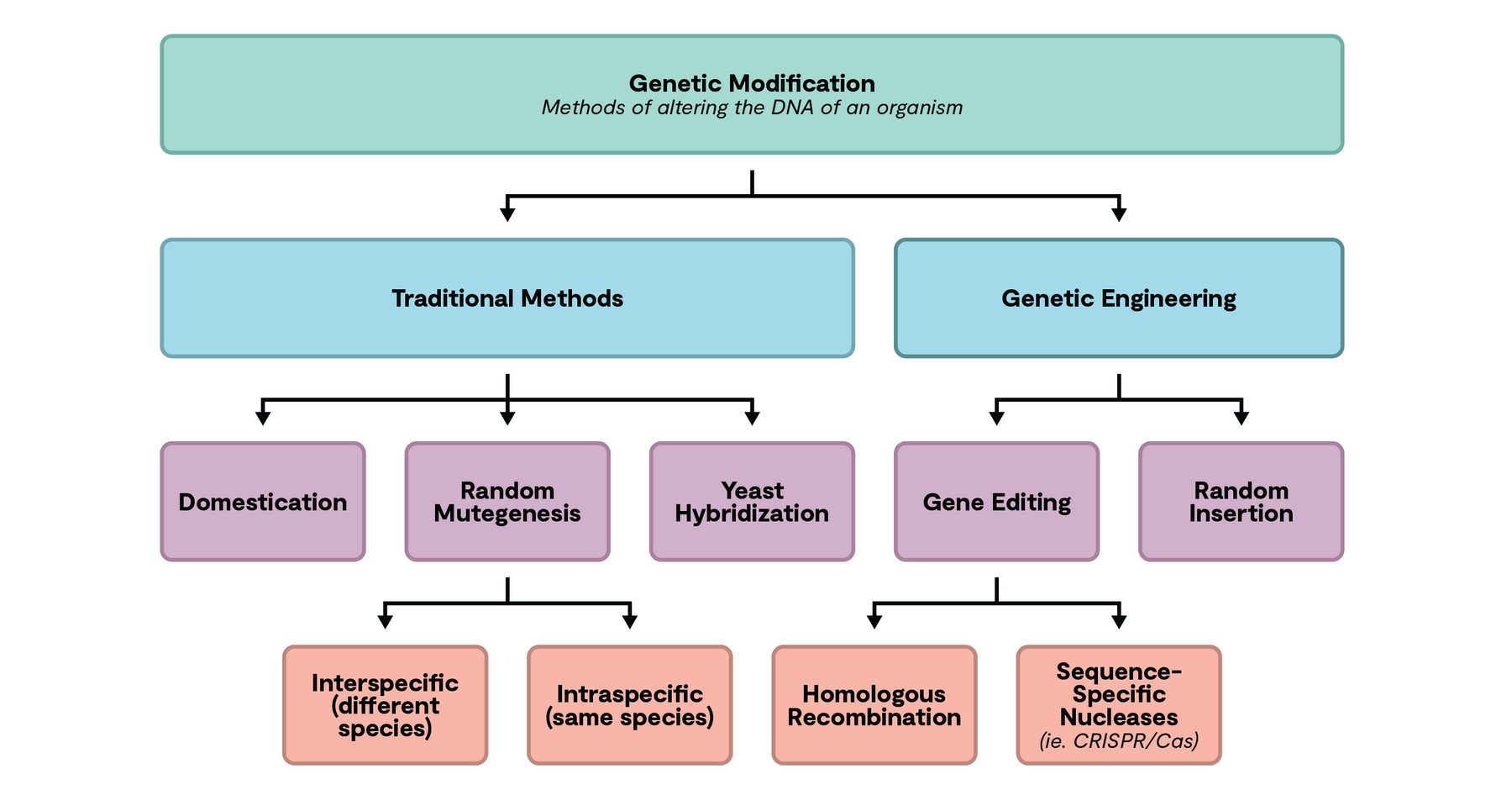
All of these forces result in modifications in yeast. With various degrees of control and intentionality, new strains appear, or are being designed, constantly.
What makes a strain "new?"
From a brewer’s perspective, a “new” strain has really always been about use and purpose, not only variety in biological iteration. So, when Omega Yeast’s R&D team applies themselves to adding new strains, they most often think about it in these two ways: they can either “sharpen” tools that already exist for brewers, or create whole new tools that allow brewers to do something they couldn’t do before. Dividing strains into these two categories also helps brewers understand how to use them better:
- Sharpened tool: A strain whose traits effect an improvement on the behavior or characteristics of a strain that is already in-use — something that builds on its capabilities and adds a new layer of utility in line with how it is already being used.
- Whole new tool: A strain whose traits introduce a new functionality, feature or outcome that expand brewers abilities and beer styles’ artistry.
Sharpening our tools
In the 1990s, there was a virus spreading around the world that decimated papaya crops. Researchers found ways to modify the papaya crop to be resistant to this virus, and effectively saved papayas from extinction. By building in this resistance, modification “sharpened” the performance of the papaya tree and its ability to successfully produce healthy fruit given its environment. The quality and character of the papaya fruit itself remained exactly the same. It was simply now able to survive an environmental challenge. We wouldn’t consider this modification to have created a “new” papaya, really. It simply improved the existing papaya.
Genetic modification with yeast offers a similar ability. Omega Yeast’s researchers can improve upon a given strain’s traits in order to optimize its brewing and fermenting properties in line with how that strain is already being used. For example, if a strain is known for being sluggish or for producing unwanted levels of a certain flavor, researchers can modify that strain to ferment more efficiently or reduce (or even eliminate) its capacity for producing certain compounds.
Diacetyl Knock Out (DKO) is a great example of a modification that Omega Yeast’s team used to “sharpen” a strain’s abilities rather than change it into a whole new tool. DKO-enabled strains can produce ALDC. Integrating the ALDC enzyme directly into cell production greatly reduces diacetyl in a finished beer brewed with these strains.
This is just one example of an improvement. Practically speaking, there are endless possibilities for sharpening the tools at a brewer’s disposal. It comes down to what they find the most useful and what changes would have a meaningful impact.
Another great opportunity for strain improvement is with haze. Both the presence and absence of haze are a hot topic for brewers. Modifications to the haze gene in new strains reinforce how a strain is already being used, whether predominantly for hazy styles or in clear ones. This change sharpens the tool by making the desired outcome easier to achieve at the point of fermentation.
Building new tools
Let’s look again at fruit to understand the concept of a new tool compared to a sharpened one. Imagine you’ve just brought home a pineapple from the store, and you’re preparing to chop it up for a little snack. You make your first slice and find that the fruit isn’t the vibrant yellow that you expected, but pink! In the early 2000s, researchers used genetic modification to cultivate a pineapple with increased levels of lycopene. This turns the fruit pink. The pink pineapple, described as sweeter and less acidic than its traditional counterpart, doesn’t necessarily replace typical pineapples. The pink flesh is not an improvement, per se. It gives consumers the variety of choice in pineapples. The pink pineapple could be used in place of regular pineapple for a different profile in your pineapple upside down cake, or could inspire a whole new dessert that showcases its novelty or new characteristics.
Just so, with yeast researchers can also modify strains in such a way that it creates an entirely new world of functionality and flavor combination. This is a bit more of a visionary step, requiring looking beyond the traditional toward the never-before-imagined. The Thiolized series of strains is an example of this sort of thinking. These strains represent a new component in the recipe-building process. For some brewers, yeast’s thiol-generating capability adds layers of flavor to their existing recipes, while others embrace them as the primary driver of aromatics in their beers. These are whole new tools.
Combining tools
One of the more prominent uses of Thiolized strains has been in fragrant dry-hopped beers. Thiols add a new layer of tropical fruit-like flavor amid a bouquet of floral and fruity hop aromatics, but these beers always come along with the risk of dry hop-induced diacetyl formation. By combining a new tool, a Thiolized strain, with the tool-sharpening capabilities of DKO technology, the fermentation will result in new and novel tropical aromas, and it will also prevent diacetyl from forming throughout the entire fermentation and maturation process. New tools and the sharpened strain’s related technologies, like diacetyl-reduction ability or haze-reduction ability, for example, can be combined to make the new traits of new tools better in a variety of beer and brewing contexts.
What’s in your toolbox?
If you look at yeast like you do your other ingredients, what are the tools you have at your disposal? You may find some processes painstaking, or maybe one of your raw materials is difficult to source, or is expensive— consider whether fermentation may be a path toward easing those issues, whether it’s expressing an enzyme to aid diacetyl cleanup, or the removal of the gene that produces phenolic flavors in beer, or even taking the best qualities of two strains and blending them into one.
