
Jul 28, 2025

In its prime, Omega Yeast’s researchers found that standard LCSM was suppressing the growth of some diastatic strains, allowing them to pass undetected. That’s alarming, since detecting diastatic strains is what we depend on LCSM to do. Omega Yeast tweaked the LCSM recipe to make it strategically more permissive: Changing the ratio of some of LCSM’s active ingredients made it possible to detect all known diastatic strains tested. See the difference when you compare the two in the experiment below.
The Experiment
Pure cultures of fifteen commonly used diastatic yeast strains were dotted on both standard LCSM and a new, optimized LCSM in certain dilution ratios. The dilutions have utility for the lab (for cell counting) but for a visual comparison here, just look for growth by row as a “yes” for likely diastatic.
Standard LCSM
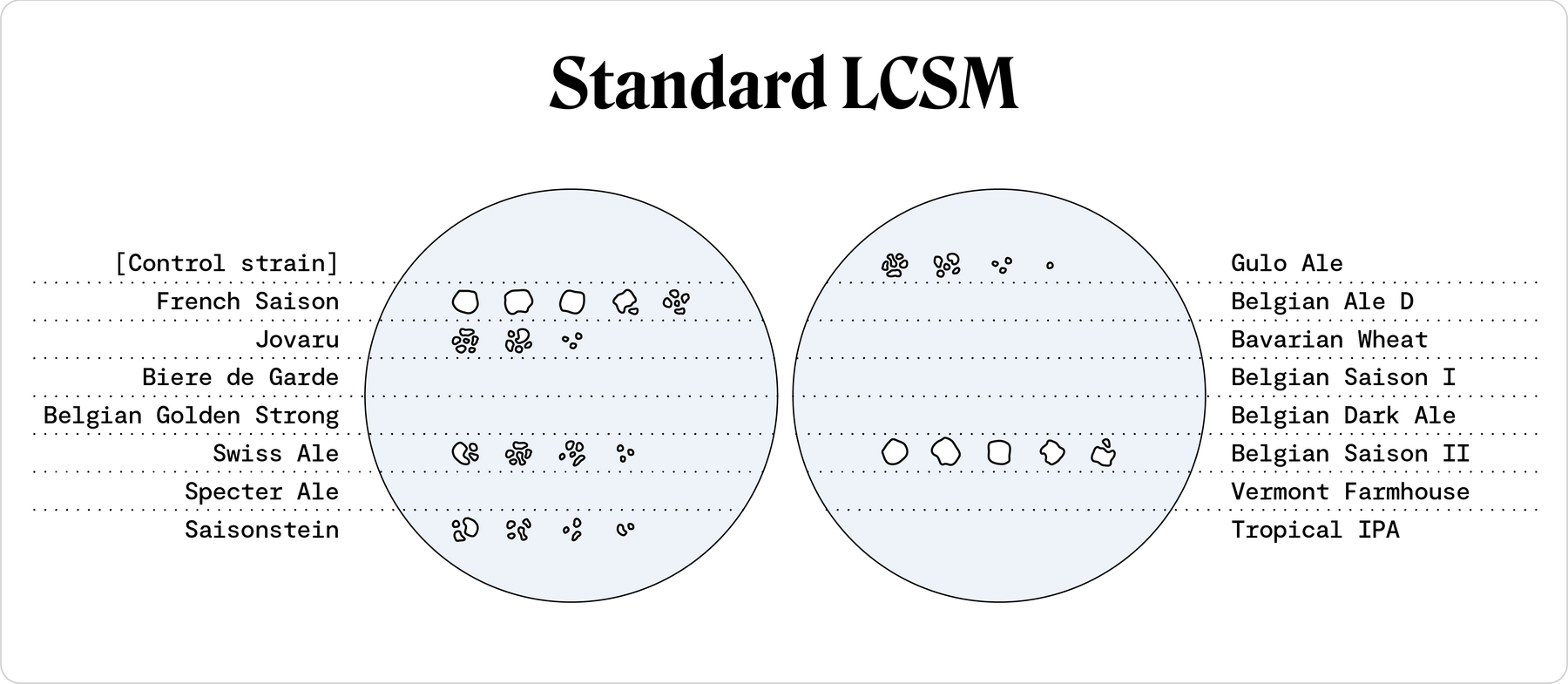
Only about six (of fifteen) diastatic strains are showing up. Real plate images here.
Results are spotty
Fifteen strains were applied to standard LCSM plates 24 hours after pouring them. This is just when LCSM plates begin to be in their prime. Yet only 6 of those strains grew. If the LCSM were screening effectively, all fifteen would be visible:
- French Saison and Belgian Saison II show the heaviest growth. Somewhat less vigorously, Jovaru, Swiss Ale, Saisonstein, and Gulo are growing, too (showing their relative levels of copper-resistance).
- The media did not detect Biere de Garde, Belgian Golden Strong, Specter Ale, Belgian Ale D, Bavarian Wheat, Belgian Saison I, Belgian Dark Ale, Belgian Saison II, Vermont Farmhouse and Tropical IPA. That means, if you’re using this media and any of those strains, you can’t trust a negative result.
Scary!
Compare with Omega Yeast Optimized LCSM
Where standard LCSM missed at least half of the diastatic strains tested, Omega Yeast’s optimized formulation allowed all of the diastatic strains to show up.
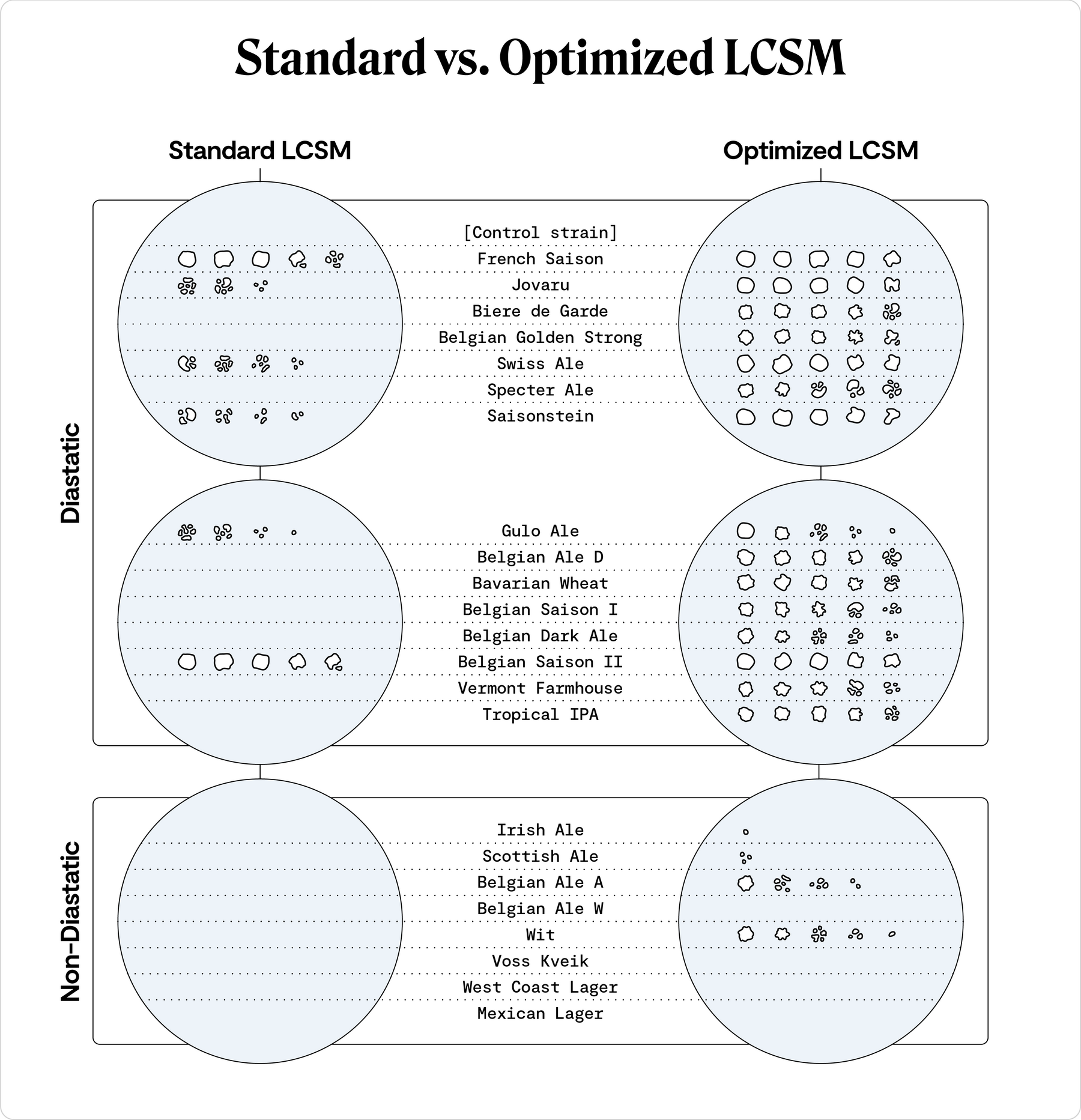
Compare standard and optimized LCSM side by side, for both diastatic and non-diastatic strains. Optimized LCSM is detecting all diastatic strains. There are now some non-diastatic strains appearing, too. Real plate images here.
Results are spot on
All diastatic strains are successfully growing on the optimized plates (top two sets of plates). But now, some non-diastatic strains (bottom plates)are getting some positive results, too. Remember, non-diastatic strains appear diastatic on this test only because they happen to be more copper-resistant relative to other non-diastatic strains.
Lesser of two evils
This is, in fact, a win: the media is still doing a good job of differentiating most diastatic strains from most non-diastatic strains; having to confirm that a few strain’s growth on LCSM is really due to the presence of diastatic yeast (a false positive), is preferable to missing any known diastatic strains.
Read more
Related Collections


