Experiment: Knocking Out Diacetyl Before it Starts
Putting ALDC to the test in a lager fermentation


By Danielle Sommer and Shana Solarte
Sep 15, 2023

Many brewers now opt to use ALDC to help control diacetyl in beer. It can either be added manually or it can be delivered via yeast that has been enabled to make it.
Though brewers are capable of optimizing processes and ingredients for reducing diacetyl without an ALDC assist, there are circumstances where using it could have a strong advantage. Like when brewing with strains that are known to be high diacetyl producers, to safeguard lagers and other styles that reveal diacetyl-related faults more easily, and in heavily dry-hopped styles.
ALDC can reduce diacetyl more thoroughly than yeast’s mechanism for cleaning up just because of how it works. We designed a brewing experiment to show diacetyl formation with and without ALDC to review those concepts.
- What exactly does ALDC do differently?
- Is there a difference whether ALDC is added in from a separate source or if you use a yeast strain that can make it on its own?
The Experiment
Using gas chromatography (GC), we measured the amounts of diacetyl that accumulated in three versions of the same FestbierIt was brewed from a single batch of wort split three ways, each fermented with a version of German Lager I. The only variable was whether there was ALDC enzyme and how it was delivered.
- Brew #1 was brewed without the help of ALDC.
- Brew #2 used exogenous ALDC (enzyme added manually) at the start of fermentation.
- Brew #3 used the DKO version of the strain, which produced its own ALDC.
The resulting data shows how diacetyl levels change in fermentations assisted by ALDC differently than in a typical lager fermentation.
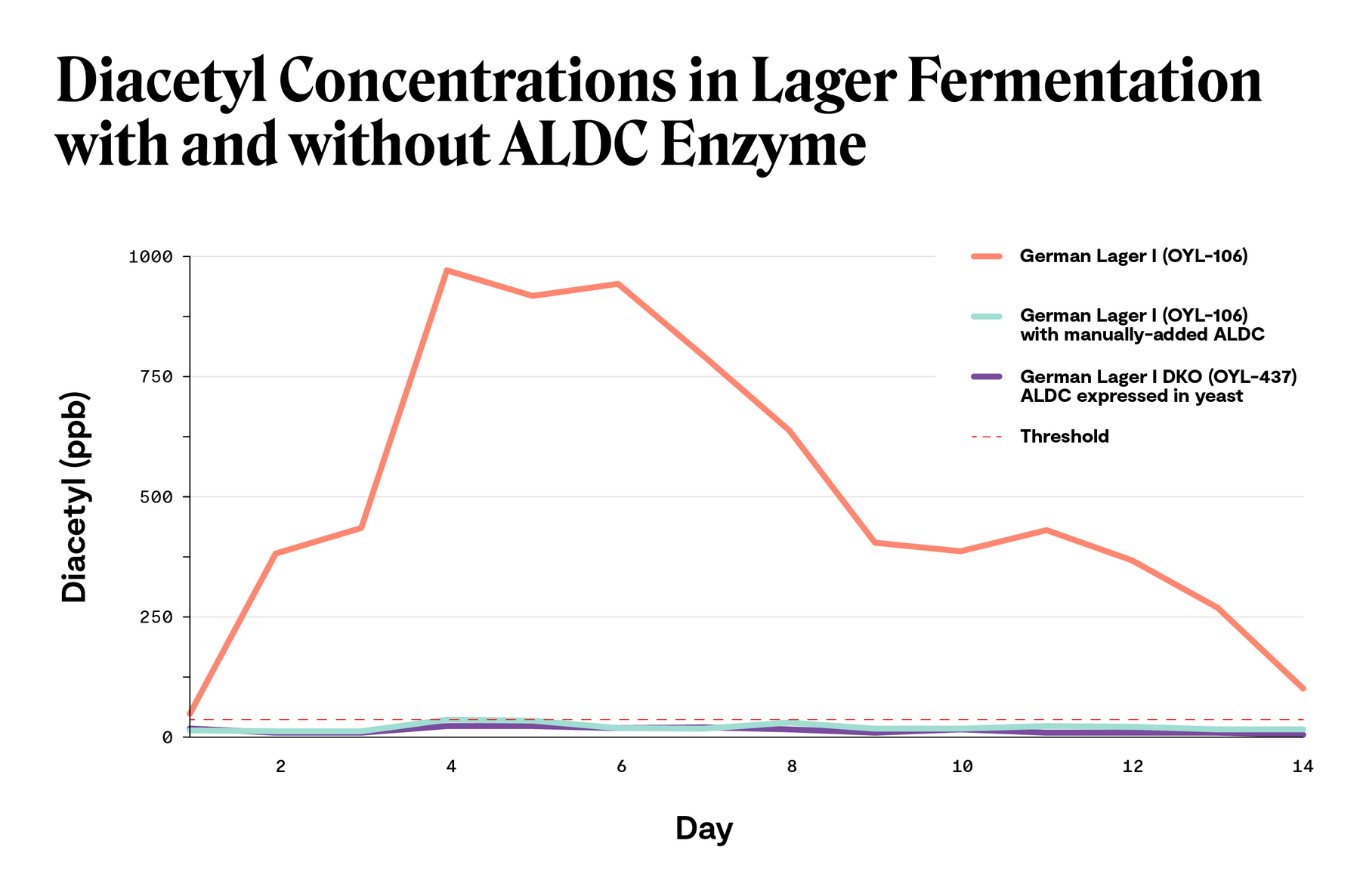
In the brew without ALDC, you see a typical diacetyl spike that later reduces when yeast cleans it up. You can also see that in the fermentation using ALDC-expressing yeast (DKO), its diacetyl control was just as successful as the one using exogenous enzyme. That’s important to note since yeast-expressed ALDC has a few additional practical and process advantages when compared to adding ALDC manually. More on that later.
Regular Lager Fermentation
Early on in fermentation, generally off-flavors are forming and yeast is very actively clearing them up. Yeast cells are producing aroma compounds like esters as part of their metabolism, and they are also making α‑acetolactate. To manage diacetyl, brewers traditionally have used techniques like a diacetyl rest at the end of fermentation. Let’s take a look at diacetyl levels throughout fermentation:
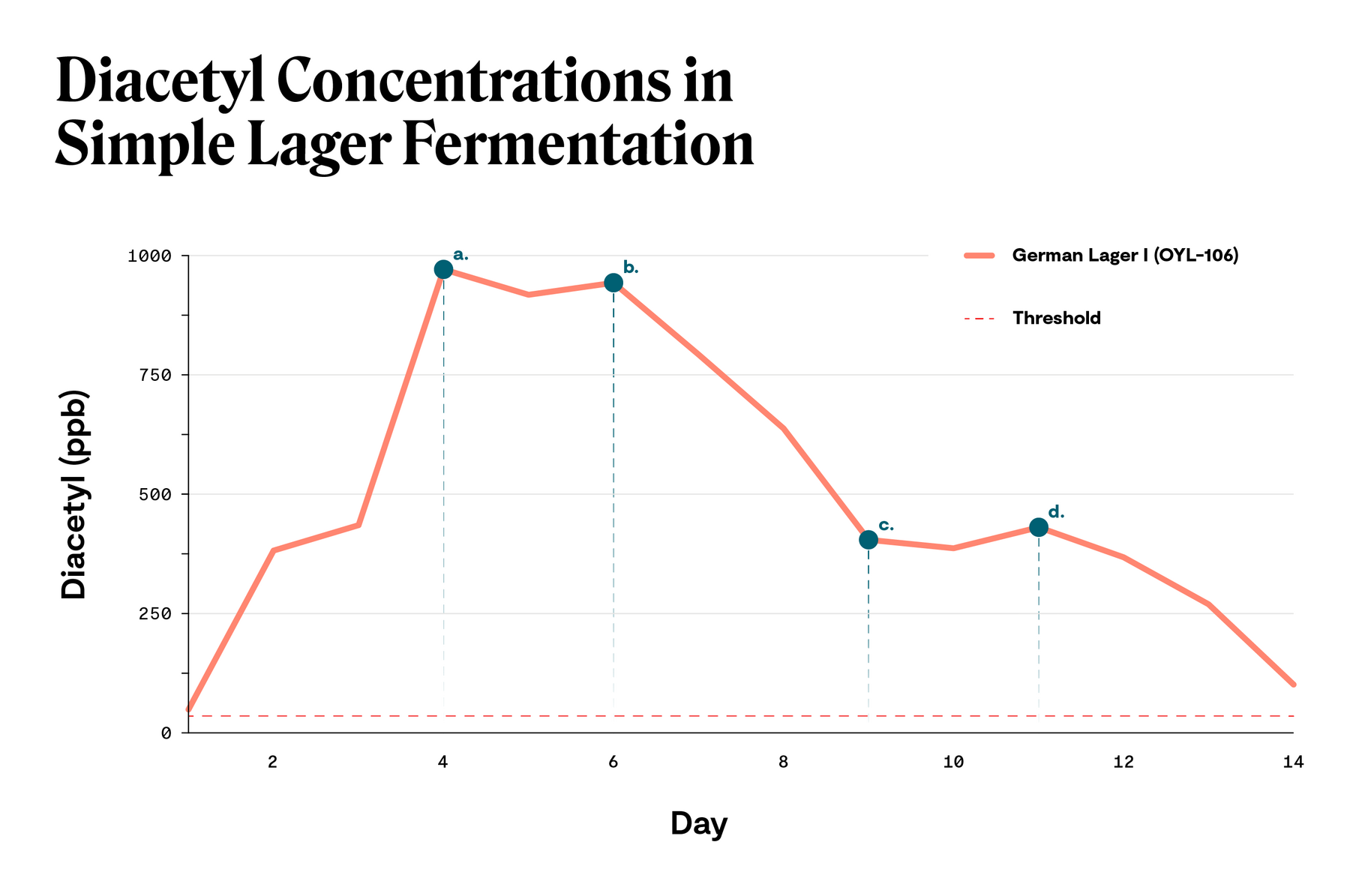
In the graph above, the orange line represents the diacetyl present in a simple German Lager I fermentation. It serves as a baseline of how diacetyl typically accumulates — and is cleared — without the help of the ALDC enzyme.
- From day zero to around day four (a.), the rate of α‑acetolactate production by yeast cells exceeds its rate of use, and the excess is becoming diacetyl in the wort. We can see that the rate of the formation of diacetyl is also pretty quickly exceeding yeast’s rate of clearance, and diacetyl concentrations are cumulatively rising.
- Mid fermentation (a.-c.), something begins to change. We see yeast’s rate of clearance exceed the rate of diacetyl formation for the first time (a.). After a sort of plateau (a.-b.), diacetyl concentrations then begin falling in earnest (b.-c.). The dramatic success in clearing diacetyl here is probably because α‑acetolacate production by yeast cells is slowing, and there is therefore less precursor available to become diacetyl. That means diacetyl’s rate of formation is slowing at the same time yeast continues to be pretty effective at clearing it.
- Nearer the end of fermentation (c.-d.), however, there’s a rise in accumulation of diacetyl compared to yeast’s effort to clear it. This is in part because diacetyl is still in the process of forming from the remaining α‑acetolactate in wort, even though yeast has slowed in producing new α‑acetolactate; but now yeast’s rate of clearing has begun to slow, too.
- Finally, increasing temperature during the diacetyl rest (c.) helps all remaining α‑acetolactate convert to diacetyl more quickly, raising diacetyl concentrations briefly (d.) and with that, also gives yeast a little extra oomph to clear it up, too.
- By day 14, diacetyl levels have tapered off to very low levels, though not entirely below threshold. Additional time would be needed to clear diacetyl in this fermentation.
The two ALDC fermentations
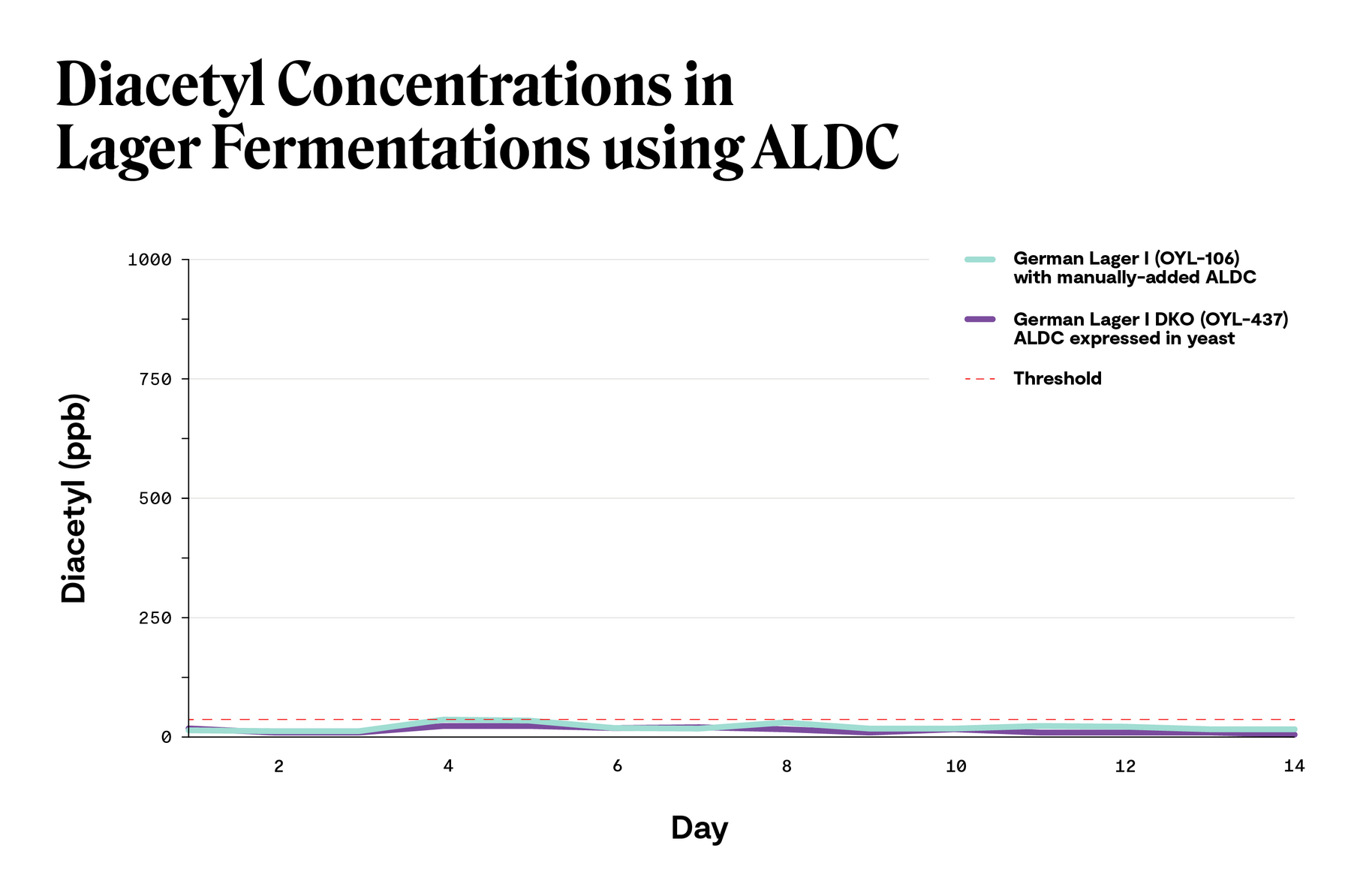
The dotted line represents the sensory threshold for diacetyl. Below that are lines representing the two ALDC-enzyme assisted fermentations. The aqua-color represents diacetyl concentrations in the fermentation where ALDC was added manually, while the purple-color shows diacetyl levels in the fermentation using the ALDC-expressing version of the strain (German Lager I DKO).
With both ALDC-assisted fermentations you can see that diacetyl formation never accumulates at all. The amounts that you do see represented in each line are more reflective of instrumental limits of detection, rather than perceivable quantities. That means diacetyl may be present, but at levels so low that they can only be detected by the GC.
A trained sensory panelist generally can begin to detect diacetyl in a pale ale starting around 40 – 50 ppb. That’s where we placed our threshold line. But in a lager, detection might be as low as 20 ppb.
Takeaways
ALDC or No?
Brewers can control diacetyl effectively with common brewing methods and processes developed for that purpose. ALDC is a tool that helps brewers control diacetyl by eliminating the precursor that would become diacetyl, and as we can see, it’s certainly an effective one. Whether used as a general safeguard, or just for particularly problematic beers is up to the brewer. Understanding how both diacetyl and ALDC work is very helpful for brewers looking to assess under what conditions they could use ALDC for the most benefit. Relying on yeast’s natural processes for clearing diacetyl can be less effective than using ALDC, especially for problematic fermentations, like when non-ideal re-pitching practices compromise yeast health, or when colder temperatures challenge yeast activity.
Add it manually or use a DKO (Diacetyl Knock Out) strain?
When it comes to using ALDC, adding exogenous ALDC, and using ALDC via an ALDC-enabled yeast strain (“DKO”) both can be more effective than yeast’s naturally occurring method. However, using an ALDC-producing yeast strain has some additional practical and functional advantages which makes it more likely to result in consistent success:
- It eliminates user-error pitfalls with timing, dosing, and other SOP considerations — like extra steps, and additional vulnerabilities for contamination.
- It stays in the cell, rather than diffusing throughout the wort, which makes it more resilient to inhibition in dry hopped beers and pH changes. Manufacturers of ALDC list optimal pH ranges starting somewhere around 4.0 – 5.0 and up to 7.0. Beer pH can occasionally dip below that, and when pH is too low, ALDC is less effective.
- And an ALDC-producing strain can surprisingly also rival or exceed exogenous ALDC in cost savings when yeast is harvested and repitched (enzyme expression is stable within yeast across generations).
(A limitation with ALDC-enabled yeast is that not all brewers can use it if they want to, since it is genetically engineered).
The Experiment’s Festbier Recipe
Vital Statistics
- Batch size 1 barrel (~31 gallons)
- Boil time 60 minutes
- IBUs 27.9
- SRM 6.1
- OG 11.5°P (1.046)
- FG 2.5°P (1.010)
- ABV 4.7%
Raw Ingredients
Malt
- Superior Pilsen
52lb (77.6%) - Aromatic malt
6lb (9%) - Vienna malt
6lb (9%) - Carapils
3lb (4.4%)
Hops
- Tettnang (4.50% AA)
6oz | Boil 60 minutes - Saaz (3.75% AA)
6oz | Boil 30 minutes - Saaz (3.75% AA)
2oz | Boil 10 minutes - Tettnang (4.50% AA)
2oz | Boil 10 minutes
Yeast
- German Lager I
(OYL-106) - German Lager I
(OYL-106) - German Lager I DKO
(OYL-437)
Other
- Enzyme
ALDC (pitch with German Lager I)
Process
Mash in at 148°F (63°C) with 1.25 qts/lb water to grist ratio (2.6L/kg). Target 5.2 – 5.3 mash pH.
Step up to 168°F (75°C) for 30 minutes. Knock out at 50°F (10°C) and split into three fermentation vessels, pitch strains accordingly, adding ALDC to one fermentor with German Lager I.
Conduct a diacetyl rest once each fermentation is about 2 – 3°P away from terminal.
Related Collections


