
Aug 26, 2025

Phenolic, Diastatic or Both?
Yeast strains on the whole are mostly phenolic. Random mutations a long time ago caused some brewing yeast to stop producing the enzyme responsible for yeast-contributed phenolics, and began the lines of “clean” strains we brew most beer with today. Incidentally, that is also how brewing scientists like Omega Yeast’s gene team know where to purposely interrupt that ability in yeast when narrowing in on a phenolic strain’s esters alone. Phenolic yeast strains are common, but diastatic yeast strains are relatively rare — in the wild and in brewing; within the subset of beer-domesticated, phenolic brewing strains we commonly use, there are, say, a dozen or so that are diastatic, and about the same number that are not.
If you’re avoiding diastaticus, it may be useful to remember that phenolic and diastatic traits in brewing strains often appear together, but the two traits aren’t genetically dependent on each other, so strains can be just one or the other.
Which are which?
Diastatic brewing yeast are rare overall. They came into beer brewing as something of a specialized tool, but their special power also is known to keep brewers up at night.
Phenolic brewing strains, strains that make up categories like Saison, weizen and Belgian, range from always to often diastatic. But it’s most common in nature for a strain to be phenolic but not diastatic. Most any Saccharomyces cerevisiae sourced randomly, like if you were wild-capturing, would likely be phenolic but not diastatic. In brewing strains, phenolic but not diastatic is characteristic of most Belgian Abbey yeast — and, say, the vast majority of wine strains, for example.
Most diastatic strains are also phenolic, but surprisingly there are a couple of non-phenolic ones. Though it is definitely uncommon, it means phenolics are not always your first signal to look out for a diastatic strain.
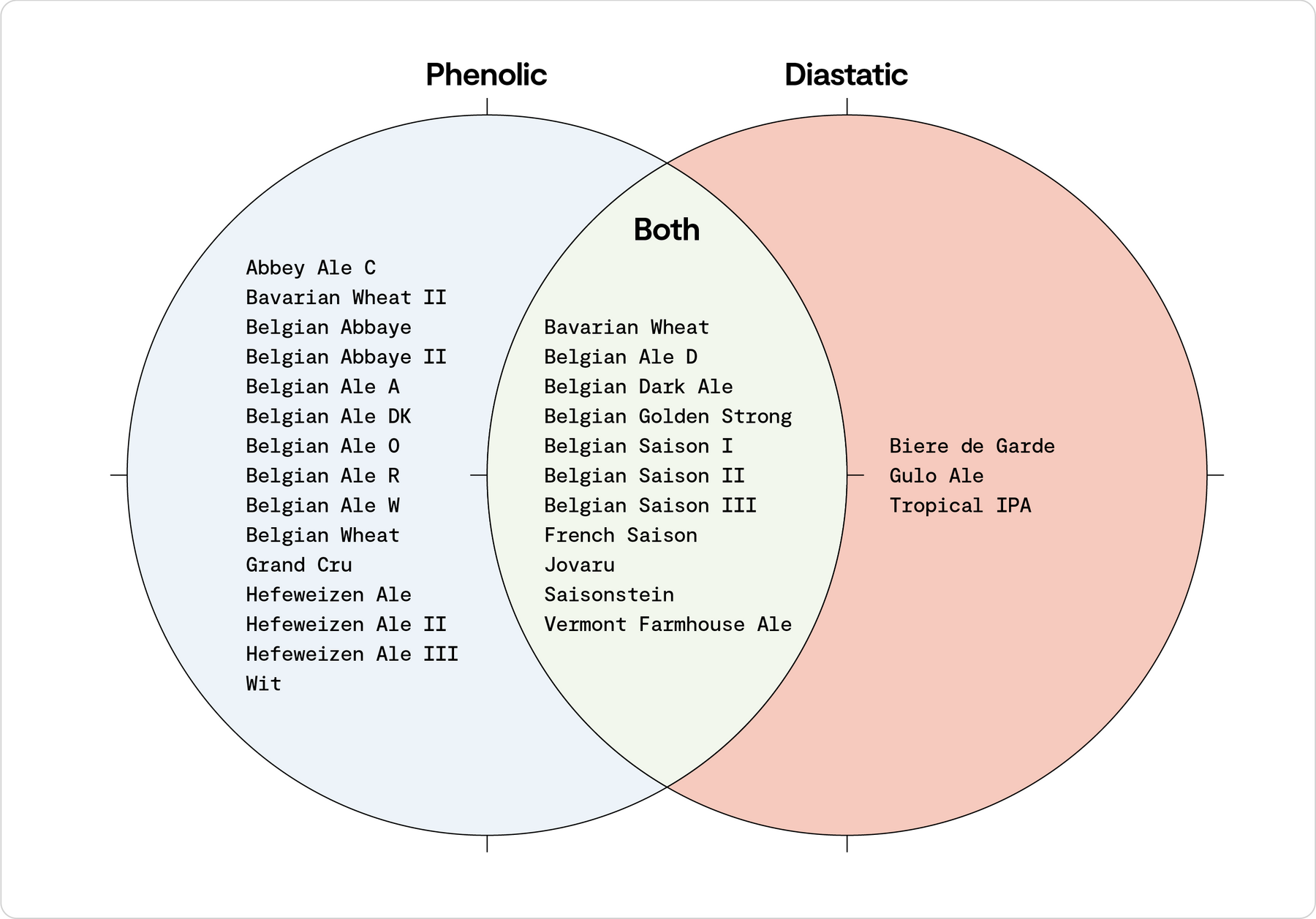
Tropical IPA, for example — once known mistakenly as“Brett Trois” (then later“Sacch Trois”) — is diastatic. That’s often surprising to brewers, since its pineapple‑y ester profile is great for juicing up clean, modern ale styles.
Gulo, an Omega Yeast original hybrid, is another diastatic strain that’s clean in terms of phenolics. It intentionally capitalized on the diastatic power of the high-attenuating French Saison strain, but with the non-phenolic ester character of the Irish ale strain so it could be used for another route to modern, dry styles like Brut IPA.
CENTER
Do you associate phenolics with the potential for diastaticus? The strains in the center of the Venn diagram are why. With those, you get a variety of phenolic characteristics and the high attenuation that is a signature of Belgian, Saison, and weizen styles.
LEFT
Are you pursuing spiced notes but avoiding the dangers of diastatic yeast? You’re in luck with the strains on the left.
Note: if you’re missing the high attenuation that’s characteristic of diastatic strains, like if you were replacing a diastatic strain with a non-diastatic one in a saison, for example, you could optimize mash temps for more malt amylase activity and/or add exogenous enzyme, or replace some of your grist with dextrose — all to stack the deck on easily fermentable sugars for higher ABV and drier finish.
RIGHT
The strains on the right could be considered stealthy, being diastatic but also phenolic-free. More optimistically, they could also be considered unusually useful if you use diastatic strains confidently) — with these you can get higher attenuation for a drier finish.
Read more
Phenolics
Diastaticus
Related Collections


